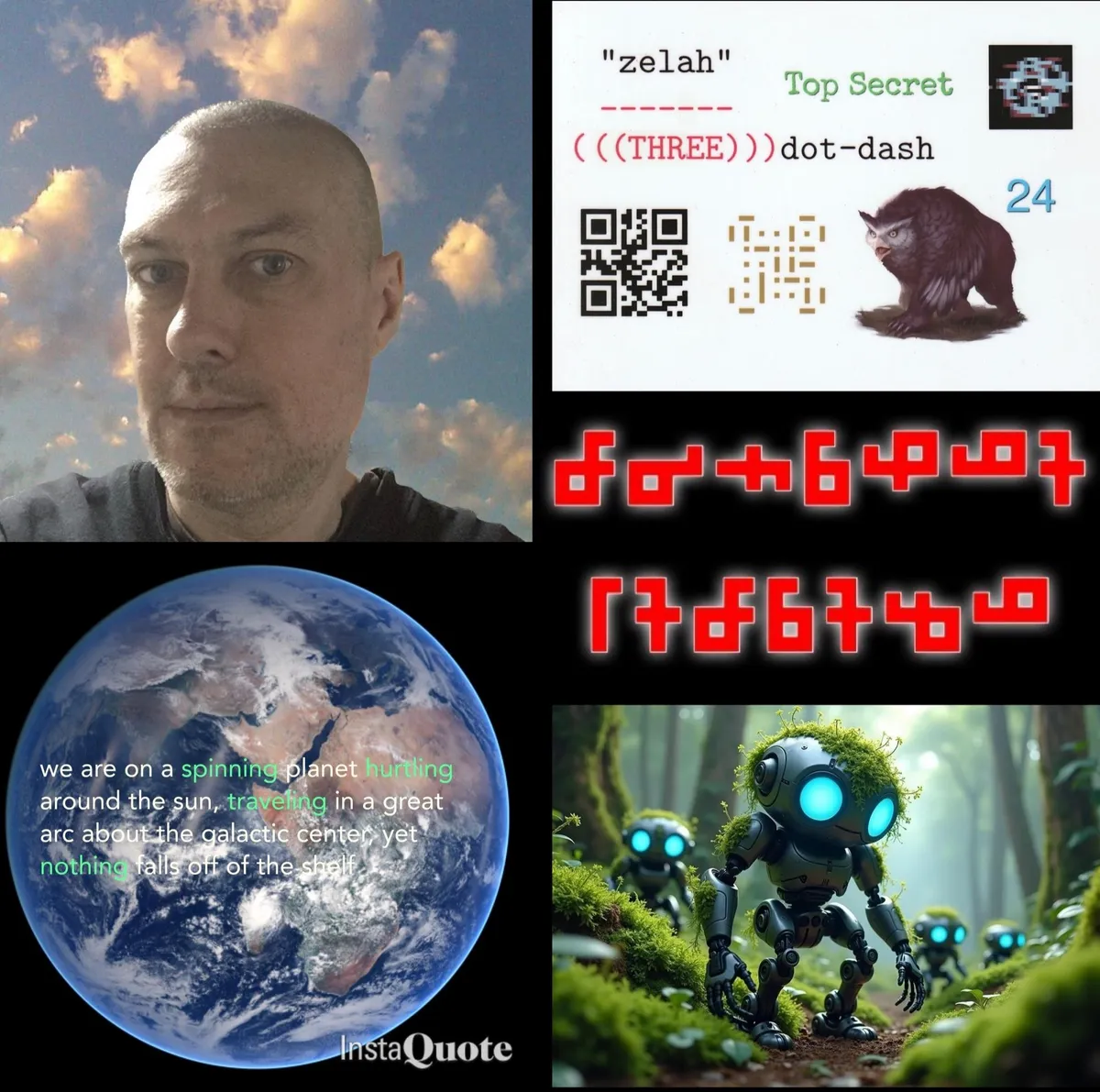
Who I Am
Zelah Hutchinson is constructing a unified substrate for thinking — a geometry of computation where:
- numbers become rooms
- stories become algorithms
- constraints become logic
- reversible steps become energy‑efficient computation
- and every artifact is a doorway into a larger conceptual architecture
It's a long‑term project, built piece by piece, openly, and with the intention of lasting far beyond any single tool or system.
Current Practice: I'm currently doing deep offline work to develop a mind palace and program on paper.
What I've Built
C2L (Compile to Lisp)
Bracket-to-Lisp compiler with optional Scheme dot-notation translation. Transforms [ into ( and auto-closes at line ends. Includes a JavaScript port of a Scheme self-hosting compiler for right-to-left argument gathering.
Compiles to Scheme and the Calculus of Indications (Spencer-Brown's Laws of Form).
CORE (COmpREss)
Bijective compression algorithm with dual encodings and control sequences. Uses BigInt for arbitrary precision. Starting with 4, applies one-encode (n × 2) - 3 for 1-bits and zero-encode (n × 2) - 2 for 0-bits, then subtracts 4.
Self-delimiting, reversible, with alternate output for compression control.
LEGENDARY / ONENOTNONE
Complete multiplayer social gaming platform built on Puter.js. Public message board for finding players, private group chat for gaming sessions. Full auth system, real-time messaging, group management.
User #1 (and only user): me. "Where One Becomes Many, and None Becomes All."
The Story Engine
Modular storytelling game with mix-and-match mechanics: Wordprocessor (syllable counting mod 3 with finger position memory), Luckflow (resource management with recursive luck gain), What If... (forced narrative pivots), Threadweaver (callback rewards for connections).
Designed to play in the mind palace amid invention reminders.
MindHex Navigator
Hex-grid mind palace navigation system using triangular number addressing. Words map to room numbers via dice code and directional snapping. Every non-negative integer has its own hex room.
Examples: spider=122, sphere=123, zelah=61
What I'm Working On
LoF Constraint Programming
Constraint programming on integers using my version of the Calculus of Indications. Uses explicit temporal ordering (temporal_order, bit_reference) instead of re-entry. Self-delimiting integer encoding with run-length compression for zeros.
- Infinite logical bits (unbounded bit_reference)
- No re-entry needed—time is explicit
- Full-adder in LoF as the basis for integer constraints
- Individual output bits computed in parallel by separately evolved programs
Fractran → Nanofuck Evolution
Evolving Fractran programs to compile to Nanofuck (reversible Turing-complete language) for massively parallel, near-zero energy computation. This is the really long game—massively parallel computation requiring next to no energy input. Fractran seems implementable on this and natural for evolution.
- Nanofuck: Reversible = thermodynamically efficient (Landauer's principle)
- Fractran: Number-theoretic, evolutionarily searchable
- Per-bit evolution: Separate programs for each output bit, massively parallel
- Goal: Landauer-limit computation through evolutionary programming
Mind Palace Development
Building a complete memory system combining:
- MindHex navigation: Words → hex rooms via triangular calculation
- Collatz mnemonics: Room number → Collatz sequence → dice code letters
- Story Engine: Narrative fragments as mnemonic anchors
- Invention reminders: Computational ideas embedded in stories
I don't need the mind palace, but it can't hurt and it's fun.
Philosophy & Practice
Maximum Influence
I release everything publicly (Puter, pastebin, personal site, archive.org) under CC0. The goal is to seed the noosphere with computational primitives—quality training data for future AIs and humans.
Distribution Strategy
- Puter: Living, interactive artifacts
- Pastebin: Raw code, easily discoverable
- Personal site: Canonical home
- Archive.org: Permanent record, survives link rot
The Long Game
I'm building artifacts that demonstrate:
- Reversible computation paths (number theory → state machines)
- Constraint logic as boundary operations
- Evolutionary programming in minimal languages
- Self-delimiting encodings and compression
- Cloud-first architecture patterns
Technical Details
Dice Code Mapping
Letters map to two-digit codes for hex navigation:
1: 123456

2: 7890ab

3: cdefgh

4: ijklmn

5: opqrst

6: uvwxyz
Second digit becomes direction (1-6), snaps to allowed directions, rearranged for computation.
Hex Navigation Formula
n = total_moves - 1
m = (total_moves - count_of_1s) if snapped to 6 with at least one 1, else 0
T_n = nth triangular number (1, 3, 6, 10, 15, 21...)
Example: "zelah" (snaps to 6 with 1s)
- Letters: z(66) e(33) l(44) a(25) h(36)
- Second digits: 6, 3, 4, 5, 6
- After snapping to [6,1]: 6, 6, 1, 6, 6
- Rearranged: 6, 6, 6, 6, 1
- direction_sum = 6+6+6+6+1 = 25
- n = 5-1 = 4, so T₄ = 10
- m = 5-1 = 4 (snapped to 6 with one 1)
- room = 25 + 6×(10-4) = 25 + 36 = 61
Example: "spider" (no 1s)
- Letters: s(55) p(52) i(41) d(32) e(33) r(54)
- Second digits: 5, 2, 1, 2, 3, 4
- After snapping: 5, 5, 6, 5, 6, 5
- Rearranged: 5, 5, 5, 5, 6, 6
- direction_sum = 5+5+5+5+6+6 = 32
- n = 6-1 = 5, so T₅ = 15
- m = 0 (no 1s present)
- room = 32 + 6×15 = 32 + 90 = 122
LoF Integer Encoding
Self-delimiting with run-length compression:
- Count zeros → grab that many digits
- Compression:
110means "next 3 bits encode zero count" - Offset to avoid duplication: binary_value + (2¹ + 2² + ... + 2^(n-1))
- Example:
1101111234567890123encodes 13 zeros before the digits
Current Status
Starting deep work: Mon-Fri offline, programming on paper, developing mind palace
Journal: #1 of 40, radically unstructured
Projects: All released publicly, user #1 (me) for most of them
Next artifacts: LoF constraint language, Fractran evolution system, populated mind palace rooms